
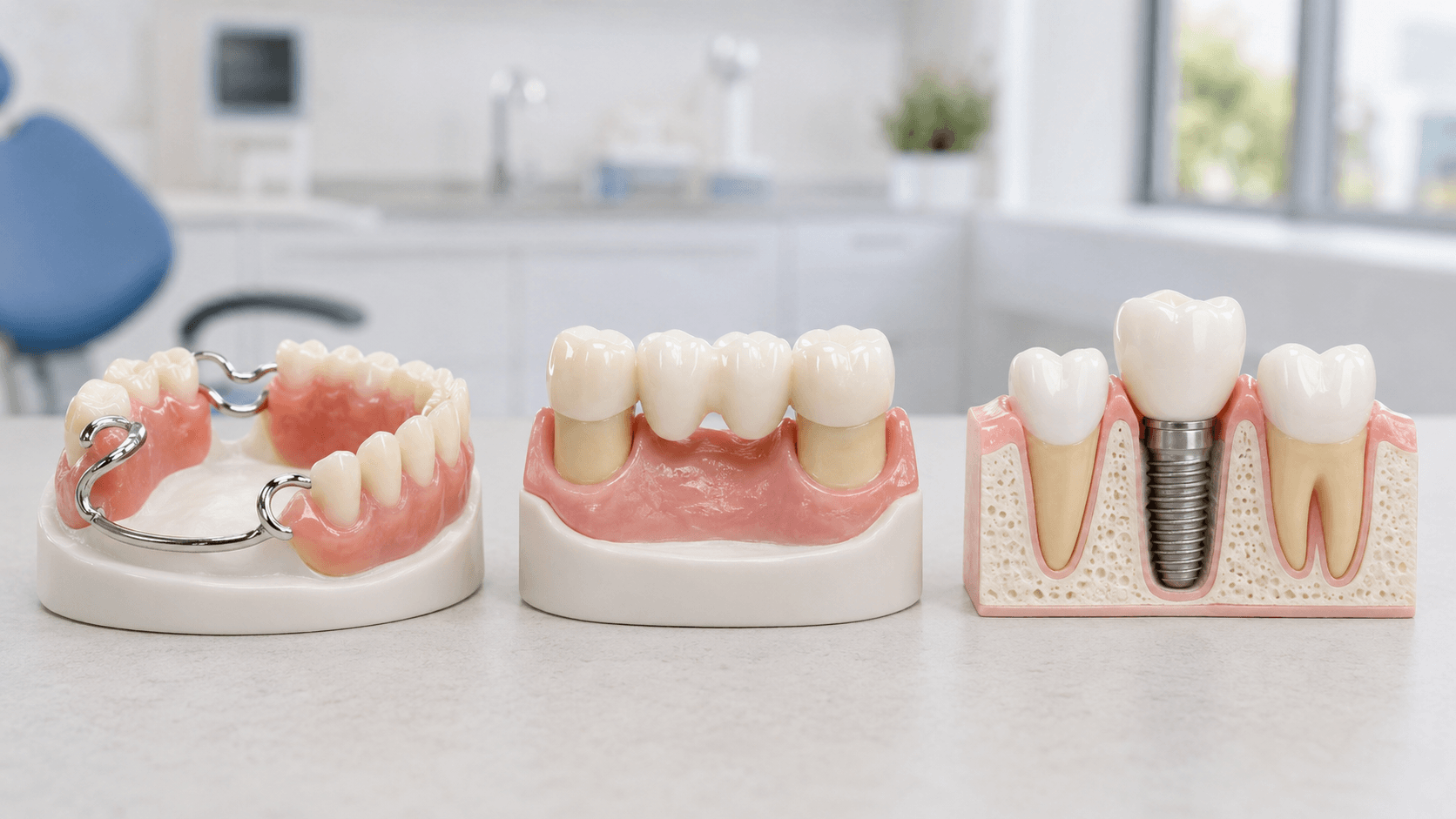
Missing teeth can often be replaced in more than one way. Dentures, bridges, and dental implants each work differently, and the right option depends on your oral health, the number and location of missing teeth, comfort preferences, goals, and the findings from a dental assessment.
Someone missing one tooth may have different options than a person missing several teeth. The condition of the remaining teeth, gums, and supporting areas can also influence the recommendation. Learning the basic differences can help you prepare useful questions for your dentist without assuming that one treatment will suit every patient.
Why Replacing Missing Teeth Matters
A missing tooth can affect more than the appearance of a smile. Depending on its location, it may influence chewing, speaking, comfort, and how the remaining teeth meet when you bite.
Nearby teeth may also shift toward an open space over time. This does not happen in exactly the same way for every person, but it is one reason to ask a dentist about replacement options rather than assuming the space can be ignored.
The effects of missing teeth depend on several details:
- How many teeth are missing
- Where the spaces are located
- How long the teeth have been missing
- The condition of the remaining teeth
- Gum and supporting tissue health
- Current dental restorations
- The patient’s bite and chewing patterns
- Personal comfort and appearance goals
Replacing missing teeth does not guarantee a specific result. The purpose of an assessment is to understand how the missing teeth affect your mouth and which options may be suitable.
Dentures, Bridges, and Dental Implants: The Basic Differences
Dentures, bridges, and dental implants can all replace missing teeth, but they use different forms of support.
Dentures are removable appliances that can replace several teeth or a full arch of teeth. Partial dentures typically use the remaining teeth for support, while complete dentures are designed for an arch where all the natural teeth are missing.
A dental bridge is generally a fixed restoration. It fills a space using support from nearby teeth or, in some situations, another form of support recommended by the dentist. The bridge is not removed for daily cleaning in the same way as a removable denture.
A dental implant is placed in the area of a missing tooth to support a restoration. Implant treatment requires careful assessment and planning. The presence of a missing tooth does not automatically mean an implant will be suitable.
Patients researching dental implants in Dunnville should compare them with other tooth replacement options. No single treatment is always best. Each has different requirements, benefits, limitations, maintenance needs, and cost factors.
When Dentures May Be Discussed
Dentures may be discussed when several teeth or all the teeth in an arch are missing. They can also be considered when the condition or arrangement of the remaining teeth makes another option less appropriate.
A partial denture replaces some missing teeth while fitting around the natural teeth that remain. A complete denture replaces a full arch. The design recommended depends on the patient’s mouth and treatment needs.
Some patients consider dentures because they offer a removable tooth replacement option. Others may compare them with fixed bridges or implant-supported restorations. During this discussion, it can be helpful to ask about:
- How the denture is supported
- How it should be inserted and removed
- Cleaning and storage requirements
- What the adjustment period may involve
- How changes in fit are monitored
- Whether repairs or replacement may eventually be needed
- How the remaining teeth and gums will be maintained
Dentures require regular care and dental examinations. Fit can change as the mouth changes, so ongoing monitoring remains important.
Patients considering full and partial dentures in Dunnville can ask how a removable option might relate to their needs. Comfort, stability, appearance, maintenance, and the condition of the mouth should all be part of the conversation.
When a Dental Bridge May Be Discussed
A dental bridge may be considered when one or more teeth are missing and there are appropriate supporting structures around the space. The bridge fills the gap with a fixed restoration that remains in the mouth during daily use.
Because the design may rely on nearby teeth, the dentist must evaluate their condition. Existing fillings, crowns, decay, fractures, gum health, and the way the teeth meet can all affect whether a bridge may be appropriate.
Questions to ask include:
- Which teeth would support the bridge?
- How would the supporting teeth need to be prepared?
- How should the area beneath the bridge be cleaned?
- How might the bridge affect nearby dental work?
- What maintenance and follow-up would be required?
- Are there other reasonable options for this space?
A fixed bridge may appeal to someone who does not want a removable appliance. However, this preference alone does not determine suitability. The dentist needs to assess the supporting teeth and surrounding tissues.
Information about fixed dental bridges in Dunnville can provide general context. A personal recommendation still requires an examination.
When Dental Implants May Be Discussed
Dental implants may be discussed when a patient is looking for a way to replace one or more missing teeth. Depending on the treatment plan, implants may support an individual restoration or contribute to a broader tooth replacement approach.
Planning involves more than examining the open space. The dentist may need to review the patient’s health history, oral health, bite, remaining teeth, and the condition of the area where the tooth is missing. Appropriate dental records or imaging may also be recommended.
Useful consultation questions include:
- What needs to be assessed before implants can be considered?
- What type of restoration could the implant support?
- Are there oral health concerns that should be addressed first?
- What other options could replace the missing tooth?
- What stages might be involved?
- What maintenance would be required?
- Which factors could affect treatment cost or timing?
Dental implants should not be described as maintenance-free or suitable for everyone. They require home care, professional monitoring, and attention to the surrounding tissues.
Patients should also avoid assuming an exact price or treatment timeline based on online information. The number of missing teeth, type of restoration, clinical findings, planning requirements, and other recommended care can all affect the process.
How a Dentist Helps Compare Your Options
Choosing tooth replacement in Dunnville begins with an assessment rather than selecting a treatment from a list. The dentist can examine your mouth, review your health and dental history, and explain which factors affect the available options.
The comparison may include:
- The number and position of missing teeth
- Health of the remaining teeth and gums
- Condition of possible supporting teeth
- Bite and chewing forces
- Current restorations
- Home-care responsibilities
- Comfort with removable or fixed options
- Treatment and maintenance requirements
- Cost factors
- Personal priorities
Your dentist should explain why an option is being recommended and what its limitations may be. If more than one approach could work, ask how they differ in daily care, support, expected follow-up, and effects on the remaining teeth.
A recommendation can also change if new information becomes available during assessment or planning. This does not necessarily mean the original discussion was incorrect. It may mean the dentist has gained a clearer understanding of the mouth.
Cost is a reasonable part of the conversation, but an online estimate cannot reflect every patient’s needs. Ask what is included in a proposed fee and whether any stages are listed separately. Insurance coverage, approval, appointment availability, and treatment timelines should not be assumed.
Frequently Asked Questions About Missing Teeth in Dunnville
What is the best option for replacing missing teeth?
There is no single best option for everyone. The appropriate choice depends on the number and location of missing teeth, oral health, supporting structures, comfort preferences, goals, and assessment findings.
A dentist can compare dentures, bridges, implants, and other options that may apply to your situation.
Are dental implants better than dentures?
Dental implants are not automatically better than dentures. They work differently and involve different treatment requirements, maintenance needs, and cost factors.
Some patients may be interested in a fixed or implant-supported option, while others may prefer or be better suited to a removable denture. Suitability must be determined through an assessment.
Can a bridge replace a missing tooth?
A bridge may be able to replace one or more missing teeth, depending on the location of the space and the condition of the supporting structures.
The dentist needs to examine the nearby teeth, gums, bite, and existing dental work before recommending a bridge.
Can dentures and implants work together?
In some treatment plans, implants may be used to support a denture. Whether this approach is appropriate depends on the patient’s oral health, anatomy, goals, and the dentist’s assessment.
Patients should not assume they are candidates for implant-supported treatment without an individual evaluation.
How do I know which option is right for me?
Begin with a dental assessment and explain what matters most to you. Ask how each option would be supported, how it would be maintained, what treatment could involve, and why the dentist recommends one approach over another.
The final decision should be based on clinical findings and a clear understanding of the reasonable options.
Talk to Dentistry Dunnville About Tooth Replacement Options
Dentures, bridges, and dental implants can all play a role in replacing missing teeth. The most suitable approach depends on your mouth, health, preferences, and treatment goals.
Patients with one or more missing teeth can contact Dentistry Dunnville to ask about arranging an assessment. The dental team can review the available options without promising candidacy, pricing, timelines, or appointment availability before an examination.

0 Comments